Sterling Silver Jewelry: Etymology Of Amethyst Part II
 The ancient Hebrew word for Amethyst was ‘Ahlamah,’ this was derived from the word ‘Halom’ meaning ‘To Dream.’ There can be little doubt that this etymology shows a strong spiritual link between the gem and its believed powers to create visions.
 In the same way the Greek ‘Amethystos’ was derived from words associated with the gems powers to prevent intoxication: ‘A,’ meaning ‘Not,’ + ‘Methyskein,’ meaning ‘Make drunk.’ This last word was derived from ‘Methys,’ meaning ‘Wine.’ The Greek compound of these words became ‘Amethystos’ which later was interpreted in Latin as ‘Amethystus,’ ‘Ametiste’ in Old French and finally ‘Amethyst’ in Middle English.
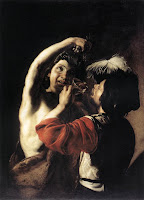 Although the exact beginning of the word Amethyst, and its connection to wine and curing drunkenness, cannot be pinpointed it must have been somewhere prior to 300 B.C. and the Septuagint who used the Greek ‘Amethystos,’ in their translation of the Old Testament. The association of Amethyst to wine may well have originated from this classical Greek tale of Bacchus, also known as Dionysus god of ecstasy, wine and the vine.
“The god Bacchus, offended at some neglect that he had suffered, was determined to avenge himself, and declared that the first person he should meet, when he and his train passed along, should be devoured by his tigers. Fate willed it that this luckless mortal was a beautiful and pure maiden named Amethyst, who was on her way to worship at the shrine of Diana. As the ferocious beasts sprang toward her, she sought the protection of the goddess, and was saved from a worse fate by being turned into a pure white stone. Recognizing the miracle and repenting of his cruelty, Bacchus poured the juice of the grape as a libation over the petrified body of the maiden, thus giving to the stone the beautiful violet hue that so charms the beholder's eye.”
 In the first century A.D. Pliny the ‘Elder’, author of the world’s first encyclopedia ‘Natural History’ gives a more practical origin and meaning behind Amethysts name: “The name which these stones* (Pliny believed there were four types of Amethyst) bear, originates, it is said, in the peculiar tint of their brilliancy, which, after closely approaching the color of wine, passes off into a violet without being fully pronounced; or else, according to some authorities, in the fact that in their purple there is something that falls short of a fiery color, the tints fading off and inclining to the color of wine.”

Next Pliny continues on Amethysts’ supposed curative powers: “The falsehoods of the magicians would persuade us that these stones are preventive of inebriety, and that it is from this that they have derived their name… statements which, in my opinion, they cannot have committed to writing without a feeling of contempt and derision for the rest of mankind.”
 Some two thousand years later J.F. Kunz, chief mineralogist for Tiffany’s, in his book ‘The Curious Lore Of Precious Stones’ gives a less skeptical and very credible reasoning behind Amethysts name and associated powers: “From the various descriptions of this stone given by ancient writers, it appears that one of the varieties was probably the purple almandine or Indian garnet, and it is not improbable that we have here the reason for the name amethyst and for the supposed virtue of the stone in preserving from drunkenness. For if water were poured into a vessel made of a reddish stone, the liquid would appear like wine, and could nevertheless be drunk with impunity.”
This article was written by David-John Turner for the Silvershake website, an online retailer of silver jewelry at wholesale prices. Purchase today and get gemstone silver jewelry worth up to $60...Free!
Copyright © www.silvershake.com. All Rights Reserved.
Some two thousand years later J.F. Kunz, chief mineralogist for Tiffany’s, in his book ‘The Curious Lore Of Precious Stones’ gives a less skeptical and very credible reasoning behind Amethysts name and associated powers: “From the various descriptions of this stone given by ancient writers, it appears that one of the varieties was probably the purple almandine or Indian garnet, and it is not improbable that we have here the reason for the name amethyst and for the supposed virtue of the stone in preserving from drunkenness. For if water were poured into a vessel made of a reddish stone, the liquid would appear like wine, and could nevertheless be drunk with impunity.”This article was written by David-John Turner for the Silvershake website, an online retailer of silver jewelry at wholesale prices. Purchase today and get gemstone silver jewelry worth up to $60...Free!
Copyright © www.silvershake.com. All Rights Reserved.